
 Overview Data & fonts Ground truth Evaluation Downloads Access & registration History Publications Team & contact
APTI is a benchmark for recognizing Arabic words across fonts, sizes, and styles, with particular attention to the challenges of low-resolution, screen-rendered text.
- 113,284 distinct Arabic words
- 45.3 millionword images in the full database
- 10 × 10 × 4fonts × sizes × styles
- XMLground truth for every word image
Published totals include all six sets. Sets 1–5 form the research distribution; set 6 is reserved for blind evaluation.
A controlled benchmark for Arabic text recognition
Introduced at ICDAR 2009, APTI supports benchmarking of open-vocabulary, multi-font, multi-size, and multi-style Arabic text recognition systems. It is a synthetically generated collection of individual word images, accompanied by detailed annotations.
The lexicon combines words generated from Arabic verb roots and morphological schemes with proper names, common names, place names, prepositions, and other words. Its sources include Ibn Khaldun’s The Muqaddimah, Gahiz’s Al-bukhala, contemporary newspaper articles, and a large lexicon produced by Slim Kanoun in 2005.
Variability comes from character ligatures and overlaps, font design, text size and style, and downsampling and antialiasing. Random white columns inserted before words create additional rendering variation. Word-image height depends on the characters present; baseline position is not supplied.
Data, fonts, and partitions
| Measure | Lexicon (one rendering) | Full database (400 renderings) |
|---|---|---|
| Word images | 113,284 | 45,313,600 |
| Pieces of Arabic words (PAWs) | 274,833 | 109,933,200 |
| Characters | 648,280 | 259,312,000 |
Sizes: 6, 7, 8, 9, 10, 12, 14, 16, 18, and 24 points. Styles: plain, italic, bold, and bold italic. Every lexicon word is rendered in 400 font–size–style combinations.
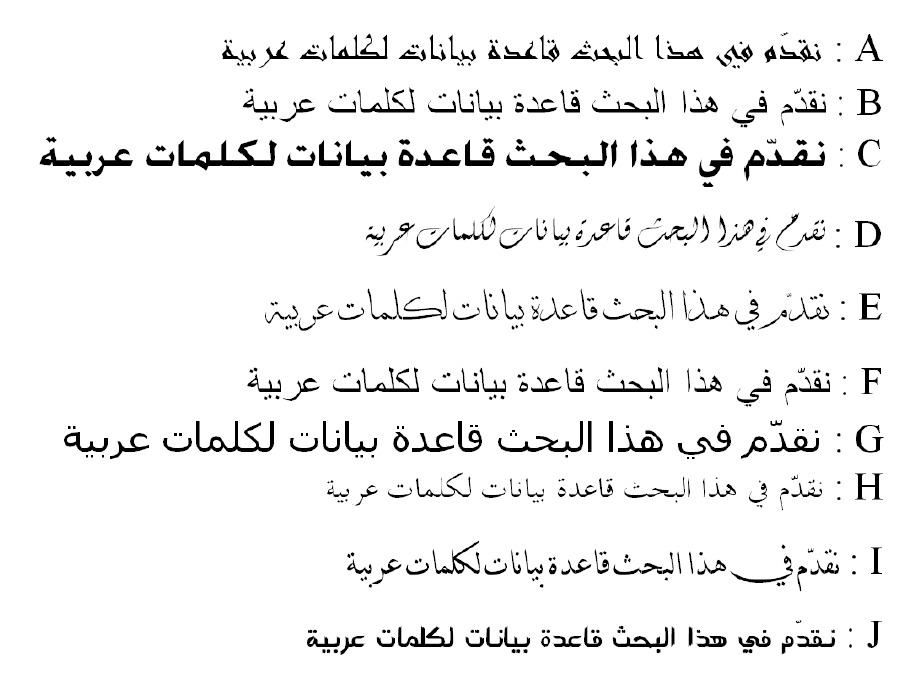
| Code | Font |
|---|---|
| A | Andalus |
| B | Arabic Transparent |
| C | AdvertisingBold |
| D | Diwani Letter |
| E | DecoType Thuluth |
| F | Simplified Arabic |
| G | Tahoma |
| H | Traditional Arabic |
| I | DecoType Naskh |
| J | M Unicode Sara |
Six disjoint sets
The lexicon is divided into six approximately balanced sets. Words differ between sets, while character distributions are similar. Sets 1–5 are supplied for research; the original competition procedures keep set 6 undisclosed for blind evaluation.
| Set | Distinct words | Access |
|---|---|---|
| 1 | 18,897 | Research distribution |
| 2 | 18,892 | Research distribution |
| 3 | 18,886 | Research distribution |
| 4 | 18,875 | Research distribution |
| 5 | 18,868 | Research distribution |
| 6 | 18,866 | Reserved for blind evaluation |
Using the published split counts, sets 1–5 contain 94,418 distinct words and 37,767,200 rendered word images. Keep the word sets separate when designing training and testing partitions so that renderings of the same lexicon words do not cross partitions unintentionally.
Character distribution in each set
| Letter label | Set 1 | Set 2 | Set 3 | Set 4 | Set 5 | Set 6 |
|---|---|---|---|---|---|---|
| Alif | 15078 | 14925 | 15165 | 15120 | 15046 | 15019 |
| Baa | 4513 | 4763 | 4692 | 4704 | 4730 | 4717 |
| Taaa | 9926 | 9884 | 9897 | 9797 | 9942 | 9897 |
| Thaa | 634 | 633 | 631 | 634 | 643 | 628 |
| Jiim | 1893 | 1897 | 1887 | 1924 | 1915 | 1939 |
| Haaa | 2953 | 2963 | 3017 | 2933 | 3000 | 3000 |
| Xaa | 1407 | 1435 | 1439 | 1401 | 1403 | 1407 |
| Daal | 3187 | 3033 | 3075 | 2990 | 3028 | 3086 |
| Thaal | 514 | 520 | 528 | 504 | 516 | 518 |
| Raa | 6304 | 6243 | 6169 | 6335 | 6253 | 6267 |
| Zaay | 1064 | 1054 | 1054 | 1066 | 1042 | 1045 |
| Siin | 3674 | 3556 | 3674 | 3512 | 3629 | 3603 |
| Shiin | 1457 | 1446 | 1418 | 1434 | 1455 | 1458 |
| Saad | 1374 | 1377 | 1388 | 1411 | 1371 | 1389 |
| Daad | 922 | 943 | 936 | 906 | 921 | 920 |
| Thaaa | 1419 | 1426 | 1431 | 1426 | 1446 | 1462 |
| Taa | 242 | 238 | 240 | 238 | 239 | 241 |
| Ayn | 2764 | 2823 | 2769 | 2718 | 2755 | 2723 |
| Ghayn | 981 | 970 | 983 | 984 | 990 | 1004 |
| Faa | 2305 | 2256 | 2221 | 2313 | 2339 | 2315 |
| Gaaf | 2784 | 2734 | 2853 | 2883 | 2762 | 2803 |
| Kaaf | 2101 | 2090 | 2099 | 2145 | 2136 | 2140 |
| Laam | 6745 | 6926 | 6972 | 7002 | 6790 | 6724 |
| Miim | 7871 | 7836 | 7957 | 7806 | 7797 | 7817 |
| Nuun | 7484 | 7433 | 7289 | 7316 | 7400 | 7264 |
| NuunChadda | 225 | 224 | 224 | 223 | 224 | 223 |
| Haa | 2670 | 2687 | 2590 | 2718 | 2705 | 2724 |
| Waaw | 4421 | 4313 | 4325 | 4333 | 4264 | 4352 |
| Yaa | 6641 | 6630 | 6876 | 6685 | 6648 | 6735 |
| YaaChadda | 725 | 727 | 709 | 719 | 735 | 733 |
| Hamza | 192 | 187 | 190 | 193 | 192 | 188 |
| HamzaAboveAlif | 1437 | 1483 | 1455 | 1512 | 1456 | 1427 |
| TaaaClosed | 1417 | 1407 | 1394 | 1364 | 1409 | 1385 |
| HamzaUnderAlif | 253 | 250 | 256 | 247 | 248 | 247 |
| AlifBroken | 162 | 161 | 164 | 163 | 161 | 161 |
| TildAboveAlif | 84 | 84 | 83 | 83 | 83 | 83 |
| HamzaAboveAlifBroken | 210 | 208 | 208 | 209 | 208 | 210 |
| HamzaAboveWaaw | 89 | 90 | 89 | 91 | 89 | 90 |
| Quantity of Characters | 108’122 | 107’855 | 108’347 | 108’042 | 107’970 | 107’944 |
| Quantity of PAWs | 45’982 | 45’740 | 45’792 | 45’884 | 45’630 | 45’805 |
| Quantity of words | 18897 | 18892 | 18886 | 18875 | 18868 | 18866 |
Download the distribution table (CSV). Counts here describe the lexicon before multiplication by the rendering combinations. The original report provides further detail about character-shape distributions.
Ground truth and annotation format
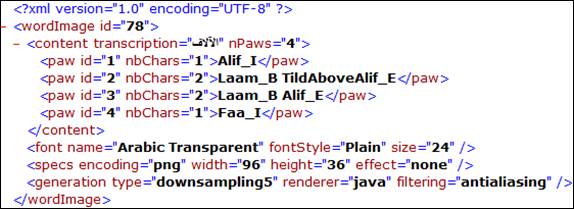
Each PNG word image has a corresponding UTF-8 XML annotation. The annotation contains four main sections:
- Content: Arabic transcription, the number of pieces of Arabic words (PAWs), and a character-label sequence for each PAW.
- Font: the font name, style, and point size.
- Specs: image format, pixel width and height, and any added effect. The original version has no added effects.
- Generation: rendering and filtering metadata. The original procedure uses Java rendering, antialiasing, and downsampling by a factor of five.
An actual annotation from the demo
<?xml version="1.0" encoding="UTF-8"?>
<wordImage id="21">
  <content transcription="الآحاد" nbPaws="4">
    <paw id="1" nbChars="1">Alif_I</paw>
    <paw id="2" nbChars="2">Laam_B TildAboveAlif_E</paw>
    <paw id="3" nbChars="2">Haaa_B Alif_E</paw>
    <paw id="4" nbChars="1">Daal_I</paw>
  </content>
  <font name="Arabic Transparent" fontStyle="Plain" size="10" />
  <specs encoding="png" width="35" height="16" effect="none" />
  <generation type="downsampling5" renderer="java" filtering="antialiasing" />
</wordImage>
Download this XML example as zip.
Character labels use English names. Positional suffixes distinguish _B (beginning), _M (middle), _E (end), and _I (isolated). Hamza has no positional suffix because it is always isolated. The labels NuunChadda and YaaChadda represent combined character shapes.
Arabic character labels, shapes, and occurrences
| Letter label | Number of Occurence | Isolate | Begin | Middle | End |
|---|---|---|---|---|---|
| Alif | 90353 | ﺍ | ﺎ | ||
| Baa | 28119 | ﺏ | ﺑ | ﺒ | ﺐ |
| Taaa | 59343 | ﺕ | ﺗ | ﺘ | ﺖ |
| Thaa | 3803 | ﺙ | ﺛ | ﺜ | ﺚ |
| Jiim | 11455 | ﺝ | ﺟ | ﺠ | ﺞ |
| Haaa | 17866 | ﺡ | ﺣ | ﺤ | ﺢ |
| Xaa | 8492 | ﺥ | ﺧ | ﺨ | ﺦ |
| Daal | 18399 | ﺩ | ﺪ | ||
| Thaal | 3100 | ﺫ | ﺬ | ||
| Raa | 37571 | ﺭ | ﺮ | ||
| Zaay | 6325 | ﺯ | ﺰ | ||
| Siin | 21648 | ﺱ | ﺳ | ﺴ | ﺲ |
| Shiin | 8668 | ﺵ | ﺷ | ﺸ | ﺶ |
| Saad | 8310 | ﺹ | ﺻ | ﺼ | ﺺ |
| Daad | 5548 | ﺽ | ﺿ | ﻀ | ﺾ |
| Thaaa | 8610 | ﻁ | ﻃ | ﻄ | ﻂ |
| Taa | 1438 | ﻅ | ﻇ | ﻈ | ﻆ |
| Ayn | 16552 | ﻉ | ﻋ | ﻌ | ﻊ |
| Ghayn | 5912 | ﻍ | ﻏ | ﻐ | ﻎ |
| Faa | 13749 | ﻑ | ﻓ | ﻔ | ﻒ |
| Gaaf | 16819 | ﻕ | ﻗ | ﻘ | ﻖ |
| Kaaf | 12711 | ﻙ | ﻛ | ﻜ | ﻚ |
| Laam | 41159 | ﻝ | ﻟ | ﻠ | ﻞ |
| Miim | 47084 | ﻡ | ﻣ | ﻤ | ﻢ |
| Nuun | 44186 | ﻥ | ﻧ | ﻨ | ﻦ |
| NuunChadda | 1343 | ﻥّ | ﻧّ | ﻨّ | ﻦّ |
| Haa | 16094 | ﻩ | ﻫ | ﻬ | ﻪ |
| Waaw | 26008 | ﻭ | ﻮ | ||
| Yaa | 40215 | ﻱ | ﻳ | ﻴ | ﻲ |
| YaaChadda | 4348 | ﻱّ | ﻳّ | ﻴّ | ﻲّ |
| Hamza | 1142 | ء | |||
| HamzaAboveAlif | 8770 | أ | ﺄ | ||
| TaaaClosed | 8376 | ﺓ | ﺔ | ||
| HamzaUnderAlif | 1501 | ﺇ | ﺈ | ||
| AlifBroken | 972 | ﻯ | ﻰ | ||
| TildAboveAlif | 500 | ﺁ | ﺂ | ||
| HamzaAboveAlifBroken | 1253 | ﺉ | ﺋ | ﺌ | ﺊ |
| HamzaAboveWaaw | 538 | ؤ | ـؤ | ||
| Quantity of Characters | 648’280 | ||||
| Quantity of PAWs | 274833 | ||||
| Quantity of words | 113’284 | ||||
Download the character-label reference (CSV). Blank contextual-form columns in the CSV indicate forms not separately shown in the original table.
Original annotation illustration
Evaluation protocols
The original website defines 20 protocols to study generalization across styles, fonts, and sizes. Tr(font, style, size) and Te(font, style, size) describe the training and testing conditions. Font codes A–J refer to the key above; p, i, b, and bi mean plain, italic, bold, and bold italic.
| Protocol name | Train choice Tr(font, Style, Size) | Test choice Te (font, Style, Size) |
|---|---|---|
| APTI 1 | Tr(B, p, 10) | Te(B, p, 10) |
| APTI 2 | Tr(B, p, 10) | Te(B, i, 10) |
| APTI 3 | Tr(B, p, 10) | Te(B, b, 10) |
| APTI 4 | Tr(B, p, 10) | Te(B, bi, 10) |
| APTI 5 | Tr(B, p, [6, 10, 14, 18]) | Te(B, p, [6, 10, 14, 18]) |
| APTI 6 | Tr(B,[p,i,b], [6, 10, 14, 18]) | Te(B,[p,i,b], [6, 10, 14, 18]) |
| APTI 7 | Tr([A,B,C,F,H], p, 10) | Te([A,B,C,F,H], p, 10) |
| APTI 8 | Tr([D,E,G,I,J], p, 10) | Te([D,E,G,I,J], p, 10) |
| APTI 9 | Tr([A,B,C,F,H], [p,i,b], 10) | Te([A,B,C,F,H], [p,i,b], 10) |
| APTI 10 | Tr([D,E,G,I,J], [p,i,b], 10) | Te([D,E,G,I,J], [p,i,b], 10) |
| APTI 11 | Tr([A,B,C], p, 10) | Te([F,H], p, 10) |
| APTI 12 | Tr([D,E,G], p, 10) | Te([I,J],i, 10) |
| APTI 13 | Tr([A,B,C], p,[6,10,14,18]) | Te([F,H], p, [6,10,14,18]) |
| APTI 14 | Tr([D,E,G], p,[6,10,14,18]) | Te([I,J], p, [6,10,14,18]) |
| APTI 15 | Tr(B, p, 6) | Te(B, p, 6) |
| APTI 16 | Tr(B, p, 8) | Te(B, p, 8) |
| APTI 17 | Tr(B, p, 10) | Te(B, p, 6) |
| APTI 18 | Tr(B, p, 6) | Te(B, p, 10) |
| APTI 19 | Tr(B, p, [6, 10, 14, 18]) | Te(B, p, [7,9,12,24]) |
| APTI 20 | Tr(all, all, all) | Te(all, all, all) |
- APTI 1: baseline with matched font, size, and style.
- APTI 2–4: transfer from plain to italic, bold, and bold italic.
- APTI 5–6: multiple sizes for a single font.
- APTI 7–10: multi-font recognition.
- APTI 11–14: recognition of fonts unseen during training.
- APTI 15–19: small-size recognition and generalization to unseen sizes.
- APTI 20: all fonts, styles, and sizes, with training and testing on separate word partitions.
The competition pages recommend following the rotation procedure described in the 2009 paper for comparable pre-evaluation results. The conditions above do not replace a word-set split; report both the rendering conditions and the partition procedure used.
Download the protocol table (CSV) · Read the detailed research report (PDF)
Downloads and resources
Explore the freely downloadable demo of 50 word images with matching annotations. The files are the original sample data, repackaged from RAR into ZIP.
- Demo: 50 word images (ZIP) Original PNG word images from set 1.
- Demo: 50 ground-truth annotations (ZIP) Corresponding XML files, matched by filename stem.
- Database and Evaluation Protocols for Arabic Printed Text Recognition (PDF) Internal research report, University of Fribourg, 2009 · 17 pages.
- Non-commercial research registration form (fillable PDF) Complete the fields, print, sign, and email the signed form to the contacts below.
- Dataset citation (BibTeX as text) Citation for the ICDAR 2009 dataset paper.
The full dataset is supplied after registration under the access policy below. The research distribution uses per-font image and ground-truth archives for sets 1–5.
Access and registration
Free for non-commercial research. The original APTI policy requires a signed registration form. For commercial use, contact the dataset contacts before using the data.
Data is supplied without a guarantee of accuracy or usability. The authors do not guarantee continued maintenance, and welcome comments and research results.
- Download the fillable registration form (PDF) and open it in a PDF reader.
- Complete your name, title, institution, postal address, and email. Students should ask their professor or supervisor to register.
- Print and sign the completed form, then scan it.
- Email the signed form to both Jean Hennebert and Fouad Slimane with the subject APTI dataset registration.
Download instructions are provided by email following registration. The form is handled by email; this page does not collect or submit applicant information.
History and ICDAR competitions
The following information summarizes the original announcements. These are historical competitions; their calls and submission deadlines are closed. The archived pages do not provide competition results.
- 2009: APTI was introduced at ICDAR in Barcelona. The original website records the official presentation announcement on 6 June 2009.
- 2011 · Beijing, 18–21 September: first Arabic Recognition Competition on multi-font, multi-size digitally represented text. It measured size effects in mono-font and multi-font recognition.
- 2013 · Washington, DC, 25–28 August: second edition, extending multi-size recognition to Arabic Transparent and DecoType Naskh and to all ten fonts.
- 2016: the website reported use by more than 100 research groups as of 30 November 2016.
- 2017 · Kyoto, 10–15 November: third competition announcement, adding font and font-size identification alongside text recognition. The call opened on 23 January; the executable submission deadline was 15 June 2017.
Competition tasks and historical submission format
Common evaluation procedure
Participants submitted executable recognizers for organizers to run on an undisclosed part of set 6. The 2013 announcement explicitly stated that participants would not receive set 6 before or after the competition. The competition tasks used plain style and sizes 6, 8, 10, 12, 18, and 24 points.
2011 tasks
The first task used Arabic Transparent, with one system per size. The second used Diwani Letter, Andalus, Arabic Transparent, Simplified Arabic, and Traditional Arabic, again evaluated by size. Evaluation used word recognition rates and character edit distance. The final registration deadline was 30 April 2011, with executable submissions also due on 30 April.
2013 tasks
- Protocol 0: Arabic Transparent, separate systems by size.
- Protocol 1: Arabic Transparent, one multi-size system.
- Protocol 2: DecoType Naskh, one multi-size system.
- Protocol 3: all ten fonts, one multi-font, multi-size system.
Metrics were word and character recognition rates (WRR and CRR). Revised registration and submission deadlines were 31 March 2013.
2017 tasks
- Identify font size independently of the font.
- Identify the font independently of font size.
- Identify font and font size jointly.
- Recognize text across all fonts and sizes.
Metrics were font recognition rate (FRR), font-size recognition rate (FSRR), word recognition rate (WRR), and character recognition rate (CRR).
Recognizer interface
The 2013 and 2017 calls used a command-line recognizer with an input list of PNG paths and an output file:
ProposedRec input.txt output.txtThe 2011 interface also allowed font and size parameters, and the 2013 size-specific task allowed ProposedRec -s size input.txt output.txt. Text recognition outputs used character labels. In the 2017 tasks, identification outputs used font labels, spelled-out size labels such as ten and twelve, or joint labels such as AdvertisingBold_ten.
Example text output in the 2017 call’s MLF format:
#!MLF!#
"D:/data/competition/Image_0.rec"
TildAboveAlif
Laam
Taaa
.
Organizers
The 2011 and 2013 calls list Fouad Slimane, Slim Kanoun, Haikal El Abed, Jean Hennebert, Rolf Ingold, and Adel M. Alimi, with DIVA, REGIM/ENIS, HES-SO Valais (2011), and the Institute for Communications Technology (IfN), Germany. The 2017 call lists Fouad Slimane (MEDIA research lab, EPFL, and DIVA), Jean Hennebert (iCoSys, College of Engineering and Architecture of Fribourg), and Rolf Ingold (DIVA, University of Fribourg). These affiliations are historical.
Publications and citation
Please cite the dataset paper when using APTI:
Fouad Slimane, Rolf Ingold, Slim Kanoun, Adel M. Alimi, and Jean Hennebert. A New Arabic Printed Text Image Database and Evaluation Protocols. Proceedings of the 10th International Conference on Document Analysis and Recognition (ICDAR 2009), Barcelona, Spain, 26–29 July 2009, pp. 946–950.
Download BibTeX citation (text)
Technical report
F. Slimane, R. Ingold, S. Kanoun, A. M. Alimi, and J. Hennebert. Database and Evaluation Protocols for Arabic Printed Text Recognition. Internal research report, Department of Informatics, University of Fribourg, Switzerland, 2009.
Competition papers listed on the original website
- Fouad Slimane, Slim Kanoun, Haikel El-Abed, Adel M. Alimi, Rolf Ingold, and Jean Hennebert. Arabic Recognition Competition: Multi-font Multi-size Digitally Represented Text. ICDAR 2011, Beijing, China, pp. 1449–1453.
- Fouad Slimane, Slim Kanoun, Haikel El-Abed, Adel M. Alimi, Rolf Ingold, and Jean Hennebert. ICDAR2013 Competition on Multi-font and Multi-size Digitally Represented Arabic Text. ICDAR 2013, Washington, DC, USA, pp. 1433–1437.
Team and contact
APTI was developed by Fouad Slimane, Rolf Ingold, Slim Kanoun, Adel M. Alimi, and Jean Hennebert, through a collaboration between:
- DIVA: Document, Image and Voice Analysis, Department of Informatics, University of Fribourg, Switzerland.
- REGIM: Research Group on Intelligent Machines, National Engineering School of Sfax (ENIS), Tunisia.
- HES-SO Valais: Software Engineering Unit, Business Information System Institute, Switzerland.
Dataset contacts
Jean Hennebert jean.hennebert@hes-so.ch
Fouad Slimane Fouad.Slimane@gmail.com
For registration, access questions, commercial use, or research feedback, contact Jean Hennebert and Fouad Slimane.